|
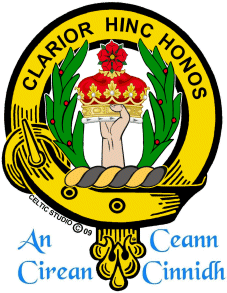
 Buchanan
|
|
The earliest family of this
name hailed from the shores of Loch Lomond, which
were granted by the Earls of Lennox to one
Absalon around 1225. "Buth chanain"is
Gaelic for "house of the canon", and Absalon may have been a clergyman or from one of
those families dedicated to the service of the
ancient Celtic Church. In 1282 Morris of Buchanan
received a charter confirming him in his lands
with baronial rights. He also held the small
island of Clarench, the name of which was
afterwards to become the battle-cry of the clan.
The Buchanans supported the cause of Bruce during
the War of Independence and the fortunes of the
family were thus assured. Sir Alexander Buchanan traveled with other Scottish nobles to fight for
the French against Henry V of England, and fought
at the Battle of Beauge in Normandy in March
1421. Buchanan's exploits during this battle
are given as one explanation for the heraldry of
this family: it is said that Sir Alexander killed
the Duke of Clarence and bore off his coronet as
a trophy, hence the ducal cap held aloft in the
crest. The shield, which is virtually the Royal
Arms of Scotland, differenced only by changing
the lion and the double tressure of fleurs de lis
from red to black. This is said to allude to the
marriage of Sir Walter Buchanan to the only
daughter of Murdoch, Duke of Albany and Regent of
Scotland. The regent was ultimately beheaded by
his cousin, James I, in 1425, when his vast
estates were confiscated. Albany's son had
died childless and the Buchanans were the nearest
relatives to this disinherited branch of the
royal family. The arms are said to mourn the
family's loss of status. Also descended from
the chiefly family were the Buchanans of Arnprior
who held lands in Perthshire around Kippen. The
Lairds of Arnprior lived in some style, and were
nicknamed the "kings of Kippen". The
laird was killed at the battle of Pinkie in 1547.
The ancient lands of Buchanan
were to have been passed at the death of the last
chief in 1682 to Buchanan of Arnprior, but
instead were sold to meet heavy debts. The
mansion house of Buchanan is now in the
possession of the Graham Dukes of Montrose.
Perhaps the most famous Buchanan was the
distinguished poet and Protestant reformer
George, who was born at Killearn in Stirlingshire
in 1506, the third son of Buchanan of Drumkill.
He moved to Paris around 1520 to continue his
education and traveled extensively on the
Continent, embarking upon a literary career. He
returned to Scotland around 1560 and in April
1562 he was appointed tutor in classics to the
young Mary, Queen of Scots. He received a measure
of royal favour but this did not prevent his
launching vicious attacks upon the queen in his
writings. He was appointed preceptor and tutor to
the young James VI after the abdication of his
mother, and he is generally credited with laying
the foundations for that monarch's
considerable academic prowess as well,
unfortunately, as poisoning the child's mind
against his mother.
James Buchanan was the
fifteenth president of the United States of
America. There has not been a recognized chief
since the late seventeenth century.
| |
|
|
|
|
| Background: Lightened Buchanan Tartan |
| Copyright ©1995-2015 by Celtic Studio |
|
Abercrombie, Abercromby, Abernethy,Adair, Agnew, Akins, Allardice, Anderson, Anstruther,
Arbuthnott, Armstrong, Arnott, Arthur, Auchinleck, Baillie, Baird,
Balfour , Ballantyne, Balmanno, Bannatyne , Bannerman, Barclay,
Baxter , Bell , Bethune, Beveridge, Bisset, Blaine, Blair, Blane, Borthwick, Boswell, Boyd,
Boyle, Brisbane, Brodie, Broun, Brown, Bruce, Buchan,
Buchanan, Burnett, Burns, Butter, Byres, Cameron (Modern), Campbell
of Argyll, Campbell of Breadalbane, Campbell of Cawdor, Campbell of
Loudoun, Carmichael, Carnegie, Carr, Carre, Carruthers, Cathcart,
Chalmers, Charteris, Chattan, Cheyne, Chisholm, Clark, Cleland,
Clelland, Cochrane, Cockburn, Colquhoun, Colville,
Congilton, Craig, Cranstoun, Crawford, Crichton, Crosbie, Cumming,
Cunningham, Dalmahoy, Dalrymple, Dalzell, Dalziel, Darroch,
Davidson, Dennistoun, Dewar, Don, Douglas, Drummond, Dunbar, Duncan, Dundas,
Dunlop, Durie,Elliott, Eliott, Elphinstone, Erskine, Falconer,
Farquharson, Ferguson, Fleming, Fletcher, Forbes, Forrester, Forsyth,
Fotheringham, Fraser, Fraser of Lovat, Fullarton, Fullerton, Galbraith,
Galloway, Garden, Gartshore, Gayre, Ged, Gibson, Gibsone, Gladstains, Glas,
Glass, Gordon, Graham, Grant, Gray, Grierson, Gunn, Guthrie, Haig, Haldane,
Haliburton, Hamilton, Hannay, Hay,
Henderson, Hepburn, Heron, Hog, Hogg, Home, Hope, Hopkirk, Horsburgh,
Houston, Hume, Hunter, Hutton, Inglis, Innes, Irvine, Jardine or Jardin,
Johnstone, Keith, Kennedy, Ker, Kerr, Kincaid, Kinloch, Kinnaird, Kinnear,
Kinninmont, Kirkcaldy, Kirkpatrick, Lammie, Lamont, Langlands, Leask, Lennox,
Leslie, Lindsay, Little, Livingstone, Lockhart, Logan, Logie, Lumsden, Lundin,
Buchanan, Lyon, Donald of Macdonald, Macafie, Mac Fie,
Macalister,
Macarthur, MacAulay, MacBain, MacBean, Macbeth, MacBrayne, MacCallum, Macdonald
of Clanranald, Macdonald of Sleat, Macdonald of the Isles, Macdonnell,
Macdougall, Macdowall, Macduff, MacEwen, Macfarlane, Macfie Ancient, Macfie
Modern, Macgillivray, Macgregor, Machlachlan, MacIan, MacInnes, Macintyre,
Maciver, Mackain, Mackay, Mackenzie of Kintail, Mackenzie of Seaforth, Mackie,
Mackinnon, Mackintosh, Maclaine, MacLaren, Maclean, Maclellan, Maclennan,
Macleod of Lewes, Macleod of Lewis, Macleod of Macleod, Macmillan, Macnab,
Macnaghten, Macnaughton, Macneacail, Macneil, Macneil (Latin Motto), Macnicol,
Mac Phee , Macpherson, Mac Phie, MacQuarrie, MacQueen, Macrae, MacTavish, Macthomas, Maitland, Makgill,
Malcolm, Mar, Marjoribanks, Masterson, Masterton, Matheson, Maule, Maxton,
Maxwell, McCorquodale, McCulloch, McKerrell, Melville, Menteith, Menzies,
Mercer, Middleton, Millar, Miller, Mitchell, Moffat,
Moncreiffe, Moncrieff, Monteith, Montgomery, Monypenny, Morehead, Morrison,
Mouat, Mow, Mowat, Muir, Muirhead, Munro, Murray, Nairn, Napier, Nesbitt, Nevoy,
Newlands, Newton, Nicolson, Ogilvy, Ogston, Oliphant, Orrock, Paisley, Paterson, Patterson, Pentland, Pitcairn, Pollock,
Preston, Primrose, Pringle, Purves, Purvis, Rait, Ralston, Ramsay, Rattray,
Riddell, Roberton, Robertson, Rollo, Rose, Ross, Russell, Rutherford, Ruthven,
Sandilands, Schaw, Scott, Scrymgeour, Sempill, Seton, Shaw, Sinclair, Skene,
Smith, Somerville, Spalding, Spens, Stewart, Stewart of Appin, Stirling, Strachan, Strang, Strange, Stuart of Bute, Sutherland, Swinton, Seaforth, Tailyour, Taylor, Thompson,
Trotter, Troup, Turnball, Tweedie, Udny, Urquhart, Vans, Walkinshaw, Wallace,
Wardlaw , Watson, Wauchope, Wedderburn , Weir, Wemyss, Whitefoord , Whitelaw,
Wilson, Wishart, Wood, Young |
CLAN BUCHANAN SEPTS
Basken, Baskin, Bede, Bonnieville, Boyne, Buck,
Buckie, Bucky, Cawsell, Chapp, Chrystal, Clapperton, Coscrach, Costie, Costy,
Cranach, Crannach, Crystall, Crystal, Crudon, Cruden, Cruddon, Colman,
Donleavy, Donlevy, Dove, Dow, Dowe, Fasken, Faskin, Fitchie, Fitchy,
Gammerie, Gammery, Gibb, Gibson, Gilbertson, Hardin, Hardman, Hardnan,
Harper, Harperson, Kermack, Leisk, Lennie, Lenny, Macaldonich, Macandeoir,
MacAslan, MacAuselan, MacAuslan, MacAusland, MacAuslane, MacCalman,
MacCalmont, MacCalmont, MacCammond, MacChruiter, MacColman, MacCormack,
MacCrystal, MacDonleavy, MacGibbon, Macgreusich, Macinally, Macindeor,
Macindoe, Mackinlay, Mackinley, MacMaster, MacMaurice, MacMurchie, MacMurchy,
Macnuyer, MacWattie, MacWhirter, Masterson, Meason, Merson, Mondie, Mondy,
Mundie, Mundy, Murchie, Murchieson, Nible, Niblo, Ogston, Ogstone, Ogstoun,
Prince, Rattliff, Ratcliff, Ratliff, Rattcliff, Risk, Runcie, Runcy, Ruskin,
Shakle, Spittal, Spittel, Tarves, Tarvis, Teunion, Teunon, Tewnion,
TinnonTucks, Wadsworth, Wadsworther, Watson, Watt, West, Whammond, Willgook,
Whyman, Whymon, Yull, Yuille, Yule. |
|