|
|

|

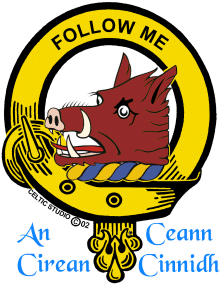
Campbell of Breadalbane
History
The east end of Loch Awe faces three valleys: Glenoe of the Mac Intyres, which winds behind Cruachan Beann to the north Glenstrae of the Mac Gregors in the centre and Glenorchy to the south, which the Campbells claimed to have obtained with a Mac Gregor heiress at the auspicious time when they supported Robert Bruce. Glenorchy, that early prize of Campbell greed, was bestowed by Sir Duncan Campbell of Loch Awe on his second son Cohn. Meanwhile, the lordship of Lorne, which the Mac Dougalls had lost through their loyalty to the true heirs to the Scottish crown, in opposition to Robert Bruce,
had passed to co-heiresses of the Stewart family. Sir Cohn of Glenorchy married Margaret Stewart, one of these co-heiresses, and thus obtained the properties that enabled him to build the castle of Kilchurn in about 1440 and to found the cadet branch of the Campbells of Breadalbane. Its chiefs are named after him Mac Callein Mhic Dhonnachaidh. Son of Cohn Son of Duncan.
It was a later Sir Cohn of Glenorchy who, by high-handedness and trickery, engineered the proscription of the Mac Gregors in 1603, thus clearing Glenstrae opposite the entrance to Kilchurn. In 1625 Black Duncan, the 7th of Glenorchy, was created a baronet. There followed the
upheavals in church and state which occasioned such vicissitudes in the parent house of Argyll. Of these the 4th baronet attempted to take advantage by
marrying a widow of the Earl of Caithness and buying up the estates of the earldom when the Gordon Earl of Sutherland, whose family had been attempting for decades to obtain it for themselves, found himself under a cloud at the Restoration of Charles II. Such a move was rare in Highland history. Although the Gordons and the Campbells sometimes clashed in the political field, they generally confined themselves to their own ample spheres of influence in their more private enterprises. Neither did Sir John of Glenorchy now succeed in obtaining the Sinclair earldom in the far north. But in 1681 he was created instead Earl of Breadalbane.
When William and Mary became joint sovereigns by the Revolution of 1688, commissioners traveled to London to offer them the Scottish crown. Argyll administered the oath when he reached the final clause William objected. until he was persuaded that he might take it with a good conscience. He then swore to root out all heretics and enemies to the true worship of God that shall be
convicted by the true Kirk of God of the foresaid crimes, out of the lands and empire of Scotland.'The Campbells had already planned the assault on their Catholic neighbours which produced such little profit and widespread obloquy in the massacre of Glencoe.
It was Dalrymple of Stair who persuaded King William to take the oath, and Dalrymple's friend, the 1st Earl of Breadalbane, who was entrusted with a fund of public money with which to buy the allegiance of Highland chiefs. But a man
who was not trusted by his friends could not secure the confidence of his enemies. A policy of coercion was consequently adopted instead, which led to the massacre. The military expedition to Glencoe was entrusted to a drunken cadet of
Glenorchy, Robert Campbell of Glenlyon. The wily Breadalbane was careful to conceal his own part in the murder of his old enemy Mac Ian of Glencoe and this
stood him in good stead when he was arrested on a charge of complicity in the massacre.
The line of Breadalbane has suffered misfortune since then. It has failed three
times and been revived again: Kilchurn is a ruin: the more modern seat of Taymouth Castle has been sold.
|
|
 | |
| |
Clan Campbell of Breadalbane Links |
| Background: Lightened Campbell of Breadalbane Tartan |
| Copyright ©1995-2015 by Celtic Studio
Abercrombie, Abercromby, Abernethy,Adair, Agnew, Akins, Allardice, Anderson, Anstruther,
Arbuthnott, Armstrong, Arnott, Arthur, Auchinleck, Baillie, Baird,
Balfour , Ballantyne, Balmanno, Bannatyne , Bannerman, Barclay, Baxter ,
Bell, Bethune, Beveridge,
Bisset, Blaine, Blair, Blane, Borthwick, Boswell, Boyd, Boyle, Brisbane,
Brodie, Broun, Brown, Bruce, Brunton, Buchan, Buchanan, Burnett, Burns,
Butter, Byres, Cameron (Modern), Campbell of Argyll, Campbell of
Breadalbane, Campbell of Cawdor, Campbell of Loudoun, Carmichael,
Carnegie, Carr, Carre, Carruthers, Cathcart, Chalmers, Charteris,
Chattan, Cheyne, Chisholm, Clark, Cleland, Clelland, Cochrane,
Cockburn, Colquhoun, Colville, Congilton, Craig, Cranstoun, Crawford,
Crichton, Crosbie, Cumming, Cunningham, Dalmahoy, Dalrymple, Dalzell,
Dalziel, Darroch, Davidson, Dennistoun, Dewar, Don, Douglas, Drummond,
Dunbar, Duncan, Dundas, Dunlop, Durie, Durward, Eliott, Elphinstone,
Erskine, Fairlie, Falconer, Farquharson, Ferguson, Fleming, Fletcher,
Forbes, Forrester, Forsyth, Fotheringham, Fraser, Fraser of Lovat,
Fullarton, Fullerton, Galbraith, Galloway, Garden, Gartshore, Gayre, Ged,
Gibson, Gibsone, Gladstains, Glas, Glass, Gordon, Graham, Grant, Gray,
Grierson, Gunn, Guthrie, Haig, Haldane, Haliburton, Halyburton, Hamilton, Hannay, Hay, Henderson, Hepburn, Heron,
Hog, Hogg, Home, Hope, Hopkirk, Horsburgh, Houston, Hume,
Hunter, Hutton, Inglis, Innes, Irvine, Jardine or Jardin, Johnstone,
Keith, Kennedy, Ker, Kerr, Kincaid, Kinloch, Kinnaird, Kinnear,
Kinninmont, Kirkcaldy, Kirkpatrick, Lammie, Lamont, Langlands, Leask,
Lennox, Leslie, Lindsay, Little, Livingstone, Lockhart, Logan, Logie,
Lumsden, Lundin, Lyle, Lyon, Donald of Macdonald,Macafie,Macalister, Macarthur, MacAulay, MacBain, MacBean,
Macbeth, MacBrayne, MacCallum, Macdonald of Clanranald, Macdonald of
Sleat, Macdonald of the Isles, Macdonnell, Macdougall, Macdowall,
Macduff, MacEwen, Macfarlane, Macfie Ancient, Macfie Modern,
Macgillivray, Macgregor, Machlachlan, MacIan, MacInnes, Macintyre,
Maciver, Mackain, Mackay, Mackenzie of Kintail, Mackenzie of Seaforth,
Mackie, Mackinnon, Mackintosh, Maclaine, MacLaren, Maclean, Maclellan,
Maclennan, Macleod of Lewes, Macleod of Lewis, Macleod of Macleod,
Macmillan, Macnab, Macnaghten, Macnaughton, Macneacail, Macneil, Macneil
(Latin Motto), Macnicol, Macphee Ancient, Macphee Modern, Macpherson,
Macphie (Ancient), Macphie (Modern), MacQuarrie, MacQueen, Macrae,
MacTavish, Macthomas, Maitland, Makgill, Malcolm, Mar, Marjoribanks,
Masterson, Masterton, Matheson, Maule, Maxton, Maxwell, MacCorquodale,
MacCulloch, MacKerrell, Melville, Menteith, Menzies, Mercer, Middleton, Millar, Miller, Mitchell, Moffat,
Moncreiffe, Moncrieff, Monteith, Montgomery, Monypenny, Morehead,
Morrison, Mouat, Mow, Mowat, Muir, Muirhead, Munro, Murray, Nairn,
Napier, Nesbitt, Nevoy, Newlands, Newton, Nicolson, Ogilvy, Ogston,
Oliphant, Orrock, Paisley, Paterson, Patterson, Pennycook, Pentland,
Peter, Pitcairn, Pollock, Porter, Porterfield, Preston, Primrose,
Pringle, Purves, Purvis, Rait, Ralston, Ramsay, Rattray, Riddell,
Roberton, Robertson, Rollo, Rose, Ross, Russell, Rutherford, Ruthven,
Sandilands, Schaw, Scott, Scrymgeour, Sempill, Seton, Shaw, Sinclair,
Skene, Skirving, Smith, Somerville, Spalding, Spens, Spottiswood,
Stewart, Stewart of Appin, Stirling, Strachan, Straiton, Strang,
Strange, Stuart of Bute, Sutherland, Swinton,, Taylor, Thompson, Trotter, Troup, Turnball,
Tweedie, Udny, Urquhart, Vans, Walkinshaw, Wallace, Wardlaw , Watson,
Wauchope, Wedderburn , Weir, Wemyss, Whitefoord , Whitelaw, Wilson,
Wishart, Wood, Young
|
|
|