|
Abercrombie, Abercromby, Abernethy,Adair, Agnew, Akins, Allardice, Anderson, Anstruther,
Arbuthnott, Armstrong, Arnott, Arthur, Auchinleck, Baillie, Baird,
Balfour , Ballantyne, Balmanno, Bannatyne , Bannerman, Barclay,
Baxter , Bell , Bethune, Beveridge, Bisset, Blaine, Blair, Blane, Borthwick, Boswell, Boyd,
Boyle, Brisbane, Brodie, Broun, Brown, Bruce, Buchan,
Buchanan, Burnett, Burns, Butter, Byres, Cameron (Modern), Campbell
of Argyll, Campbell of Breadalbane, Campbell of Cawdor, Campbell of
Loudoun, Carmichael, Carnegie, Carr, Carre, Carruthers, Cathcart,
Chalmers, Charteris, Chattan, Cheyne, Chisholm, Clark, Cleland,
Clelland, Cochrane, Cockburn, Colquhoun, Colville,
Congilton, Craig, Cranstoun, Crawford, Crichton, Crosbie, Cumming,
Cunningham, Dalmahoy, Dalrymple, Dalzell, Dalziel, Darroch,
Davidson, Dennistoun, Dewar, Don, Douglas, Drummond, Dunbar, Duncan, Dundas,
Dunlop, Durie,Elliott, Eliott, Elphinstone, Erskine, Falconer,
Farquharson, Ferguson, Fleming, Fletcher, Forbes, Forrester, Forsyth,
Fotheringham, Fraser, Fraser of Lovat, Fullarton, Fullerton, Galbraith,
Galloway, Garden, Gartshore, Gayre, Ged, Gibson, Gibsone, Gladstains, Glas,
Glass, Gordon, Graham, Grant, Gray, Grierson, Gunn, Guthrie, Haig, Haldane,
Haliburton, Hamilton, Hannay, Hay,
Henderson, Hepburn, Heron, Hog, Hogg, Home, Hope, Hopkirk, Horsburgh,
Houston, Hume, Hunter, Hutton, Inglis, Innes, Irvine, Jardine or Jardin,
Johnstone, Keith, Kennedy, Ker, Kerr, Kincaid, Kinloch, Kinnaird, Kinnear,
Kinninmont, Kirkcaldy, Kirkpatrick, Lammie, Lamont, Langlands, Leask, Lennox,
Leslie, Lindsay, Little, Livingstone, Lockhart, Logan, Logie, Lumsden, Lundin,
Lyle, Lyon, Donald of Macdonald, Macafie, Mac Fie,
Macalister,
Macarthur, MacAulay, MacBain, MacBean, Macbeth, MacBrayne, MacCallum, Macdonald
of Clanranald, Macdonald of Sleat, Macdonald of the Isles, Macdonnell,
Macdougall, Macdowall, Macduff, MacEwen, Macfarlane, Macfie Ancient, Macfie
Modern, Macgillivray, Macgregor, Machlachlan, MacIan, MacInnes, Macintyre,
Maciver, Mackain, Mackay, Mackenzie of Kintail, Mackenzie of Seaforth, Mackie,
Mackinnon, Mackintosh, Maclaine, MacLaren, Maclean, Maclellan, Maclennan,
Macleod of Lewes, Macleod of Lewis, Macleod of Macleod, Macmillan, Macnab,
Macnaghten, Macnaughton, Macneacail, Macneil, Macneil (Latin Motto), Macnicol,
Mac Phee , Macpherson, Mac Phie, MacQuarrie, MacQueen, Macrae, MacTavish, Macthomas, Maitland, Makgill,
Malcolm, Mar, Marjoribanks, Masterson, Masterton, Matheson, Maule, Maxton,
Maxwell, McCorquodale, McCulloch, McKerrell, Melville, Menteith, Menzies,
Mercer, Middleton, Millar, Miller, Mitchell, Moffat,
Moncreiffe, Moncrieff, Monteith, Montgomery, Monypenny, Morehead, Morrison,
Mouat, Mow, Mowat, Muir, Muirhead, Munro, Murray, Nairn, Napier, Nesbitt, Nevoy,
Newlands, Newton, Nicolson, Ogilvy, Ogston, Oliphant, Orrock, Paisley, Paterson, Patterson, Pentland, Pitcairn, Pollock,
Preston, Primrose, Pringle, Purves, Purvis, Rait, Ralston, Ramsay, Rattray,
Riddell, Roberton, Robertson, Rollo, Rose, Ross, Russell, Rutherford, Ruthven,
Sandilands, Schaw, Scott, Scrymgeour, Sempill, Seton, Shaw, Sinclair, Skene,
Smith, Somerville, Spalding, Spens, Stewart, Stewart of Appin, Stirling, Strachan, Strang, Strange, Stuart of Bute, Sutherland, Swinton, Seaforth, Tailyour, Taylor, Thompson,
Trotter, Troup, Turnball, Tweedie, Udny, Urquhart, Vans, Walkinshaw, Wallace,
Wardlaw , Watson, Wauchope, Wedderburn , Weir, Wemyss, Whitefoord , Whitelaw,
Wilson, Wishart, Wood, Young
|























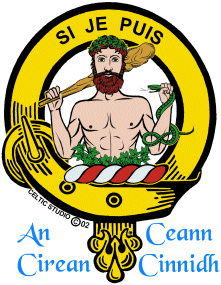
 Livingston