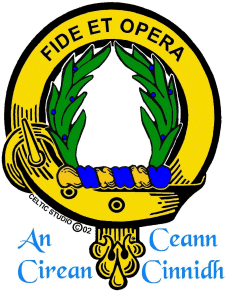
Mac Arthur
|
|
After the Roman legions had left, the British
kingdoms of southern Scotland fought to maintain themselves against the Picts
and the Scots to their north, and against the expansionist English of
Northumbria to their south. In their Welsh language the earliest surviving
Scottish poem was composed, telling of the defeat of the Gododdin heroes by the
English; and this poem contains far the earliest reference to the British
resistance leader, Arthur. When the old British kingdoms of Gododdin,
Strathclyde and Rheged had vanished, the traditions of the Men of the North were
preserved in Wales - the only part of the once predominantly British isles in
which their language remains to this day. The story of Arthur traveled south
until he was given a new setting as far south as Tintagel in Welsh-speaking
Cornwall.
Meanwhile Arthur
s Seat commemorated him in the lands of the Gododdin, while
to the north of Strathclyde the Mac Arthur's were tracing their descent in the
13th century from the legendary hero. It was a Mac Arthur who at this time
married the heiress of Duncan mac Duibhne of Loch Awe. This was before the
nickname Cam beul gave rise to the surname of Campbell, who are also called the
Clanh Ua Duibhne. Mac Arthur may therefore be regarded as an earlier name of the
same race. It was also one of considerable consequence until James I returned
from his long captivity in England, and fell like a thunderbolt on the magnates
of his realm. In 1427 lain Mac Arthur shared the fate of the king
s nearest
relatives who had suffered execution and forfeiture. Thereafter it was the
surname of Campbell which flourished in this region beyond the ancient capital
of Strathclyde on Dumbarton Rock.
But in modern times the name of Mac Arthur has been carried to the ends of the
earth. John Mac Arthur (1767-1834) belonged to a family that had already
emigrated, since he was born in Devonshire. In 1790 he arrived with his regiment
in New South Wales, where he was Commandant at Parramatta from 1793 until 1804.
In 1794 he laid the foundations of the wool industry in Australia by crossing
Bengal with Irish sheep, and then introducing merino sheep from Africa. Later he
traveled throughout Europe with his sons, studying wine production, and in 1817
he planted the first Australian vineyard. When Bligh of the Bounty was appointed
Governor, he attempted to arrest Mac Arthur in 1807, but he had met his match.
Mac Arthur arrested Bligh in turn. He was a quarrelsome man, as two Scots who
followed Bligh in the post of Governor, Sir Thomas Makdougall Brisbane of
Brisbane and Lachlan Mac Quarie, were to discover to their cost. But he founded
a continent
s two great industries of wine and wool, and justly ranks as a
Father of Australia.
His name has been carried to even greater renown in the United States of
America, where it was brought in about 1840 by an emigrant from the former lands
of Strathclyde, in which Glasgow now lies. His son Arthur Mac Arthur entered the
army, a career that was followed by his son General Douglas Mac Arthur
(1880-1964). |
|
|
|
| |
Clan Mac Arthur Links |
|
Background: Lightened Anderson Tartan |
|
Copyright ©1995-2015 by Celtic Studio |
|
Abercrombie, Abercromby, Abernethy,Adair, Agnew, Akins, Allardice, Anderson, Anstruther,
Arbuthnott, Armstrong, Arnott, Arthur, Auchinleck, Baillie, Baird,
Balfour , Ballantyne, Balmanno, Bannatyne , Bannerman, Barclay,
Baxter , Bell , Bethune, Beveridge, Bisset, Blaine, Blair, Blane, Borthwick, Boswell, Boyd,
Boyle, Brisbane, Brodie, Broun, Brown, Bruce, Buchan,
Buchanan, Burnett, Burns, Butter, Byres, Cameron (Modern), Campbell
of Argyll, Campbell of Breadalbane, Campbell of Cawdor, Campbell of
Loudoun, Carmichael, Carnegie, Carr, Carre, Carruthers, Cathcart,
Chalmers, Charteris, Chattan, Cheyne, Chisholm, Clark, Cleland,
Clelland, Cochrane, Cockburn, Colquhoun, Colville,
Congilton, Craig, Cranstoun, Crawford, Crichton, Crosbie, Cumming,
Cunningham, Dalmahoy, Dalrymple, Dalzell, Dalziel, Darroch,
Davidson, Dennistoun, Dewar, Don, Douglas, Drummond, Dunbar, Duncan, Dundas,
Dunlop, Durie,Elliott, Eliott, Elphinstone, Erskine, Falconer,
Farquharson, Ferguson, Fleming, Fletcher, Forbes, Forrester, Forsyth,
Fotheringham, Fraser, Fraser of Lovat, Fullarton, Fullerton, Galbraith,
Galloway, Garden, Gartshore, Gayre, Ged, Gibson, Gibsone, Gladstains, Glas,
Glass, Gordon, Graham, Grant, Gray, Grierson, Gunn, Guthrie, Haig, Haldane,
Haliburton, Hamilton, Hannay, Hay,
Henderson, Hepburn, Heron, Hog, Hogg, Home, Hope, Hopkirk, Horsburgh,
Houston, Hume, Hunter, Hutton, Inglis, Innes, Irvine, Jardine or Jardin,
Johnstone, Keith, Kennedy, Ker, Kerr, Kincaid, Kinloch, Kinnaird, Kinnear,
Kinninmont, Kirkcaldy, Kirkpatrick, Lammie, Lamont, Langlands, Leask, Lennox,
Leslie, Lindsay, Little, Livingstone, Lockhart, Logan, Logie, Lumsden, Lundin,
Lyle, Lyon, Donald of Macdonald, Macafie, Mac Fie,
Macalister,
Macarthur, MacAulay, MacBain, MacBean, Macbeth, MacBrayne, MacCallum, Macdonald
of Clanranald, Macdonald of Sleat, Macdonald of the Isles, Macdonnell,
Macdougall, Macdowall, Macduff, MacEwen, Macfarlane, Macfie Ancient, Macfie
Modern, Macgillivray, Macgregor, Machlachlan, MacIan, MacInnes, Macintyre,
Maciver, Mackain, Mackay, Mackenzie of Kintail, Mackenzie of Seaforth, Mackie,
Mackinnon, Mackintosh, Maclaine, MacLaren, Maclean, Maclellan, Maclennan,
Macleod of Lewes, Macleod of Lewis, Macleod of Macleod, Macmillan, Macnab,
Macnaghten, Macnaughton, Macneacail, Macneil, Macneil (Latin Motto), Macnicol,
Mac Phee , Macpherson, Mac Phie, MacQuarrie, MacQueen, Macrae, MacTavish, Macthomas, Maitland, Makgill,
Malcolm, Mar, Marjoribanks, Masterson, Masterton, Matheson, Maule, Maxton,
Maxwell, McCorquodale, McCulloch, McKerrell, Melville, Menteith, Menzies,
Mercer, Middleton, Millar, Miller, Mitchell, Moffat,
Moncreiffe, Moncrieff, Monteith, Montgomery, Monypenny, Morehead, Morrison,
Mouat, Mow, Mowat, Muir, Muirhead, Munro, Murray, Nairn, Napier, Nesbitt, Nevoy,
Newlands, Newton, Nicolson, Ogilvy, Ogston, Oliphant, Orrock, Paisley, Paterson, Patterson, Pentland, Pitcairn, Pollock,
Preston, Primrose, Pringle, Purves, Purvis, Rait, Ralston, Ramsay, Rattray,
Riddell, Roberton, Robertson, Rollo, Rose, Ross, Russell, Rutherford, Ruthven,
Sandilands, Schaw, Scott, Scrymgeour, Sempill, Seton, Shaw, Sinclair, Skene,
Smith, Somerville, Spalding, Spens, Stewart, Stewart of Appin, Stirling, Strachan, Strang, Strange, Stuart of Bute, Sutherland, Swinton, Seaforth, Tailyour, Taylor, Thompson,
Trotter, Troup, Turnball, Tweedie, Udny, Urquhart, Vans, Walkinshaw, Wallace,
Wardlaw , Watson, Wauchope, Wedderburn , Weir, Wemyss, Whitefoord , Whitelaw,
Wilson, Wishart, Wood, Young |
|