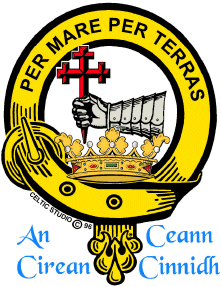
Beath, Beaton, Bethune, Bowie, Colson, Connall,
Connell, Darroch, Donald, Donaldson, Donillson, Donnelson, Drain, Galbraith,
Gilbride, Gorrie, Gowan, Gowrie, Hawthorn, Hewison, Houstoun, Howison, Hughson, Hutcheonson, Hutchinson, Hutchison, Isles, Kellie, Kelly, Kinnell, Mac a' Challies, MacBeth, MacBeath, MacBheath, MacBride, MacCaishe, MacCall, MacCash, MacCeallaich, MacCodrum, MacColl, MacConnell, MacCook, MacCooish, MacCrain,
MacCuag, MacCuish, MacCuitein, MacCutcheon, MacDaniell, Macdrain, MacEachern, MacElfrish, MacElheran, MacGorrie, MacGorry, MacGoun, MacGowan, MacGown, MacHugh, MacHutchen, MacHutcheon, MacIan, Macilreach, Macilriach, Macilleriach, Macilrevie, Macilvride, Macilwraith, MacKean, MacKellachie, MacKellaig,
MacKelloch, MacKiggan, MacKinnell, MacLairish, MacLardie, MacLardy, MacLarty, MacLaverty, MacLeverty, MacMurchie, MacMurdo, MacMurdoch, MacO'Shannaig, MacQuistan, MacQuisten, MacRaith, MacRorie, MacRory, MacRuer, MacRurie, MacShannachan, MacSorley, MacSporran, MacSwan, MacWhannell, Martin, May, Murchie,
Murchison, Murdoch, Murdoson, O'Drain, O';May, O'Shannachan, O';Shaig, O'Shannaig, Purcell, Revie, Reoch, Riach, Rorison, Shannon, Sorley, Sporran, Train, Whannel.Clan Mac Donald of Clanranald: Allan, Allanson, Currie, MacAllan, MacBurie, MacEachin, MacGeachie, MacGeachin, MacIssac, MacKeachan, Mackechnie,
MacKeochan, MacKessock, MacKichan, MacKissock, MacMurrich, MacVarish, MacVurrich, MacVurie, Clan Mac Donald of Ardnamurchan, Johnson, Kean, Keene.
Clan Mac Donald of Glencoe: Henderson, Johnson, Kean, Keene, MacHenry, MacIan, MacKean.
|























 Mac
Donald
Mac
Donald